

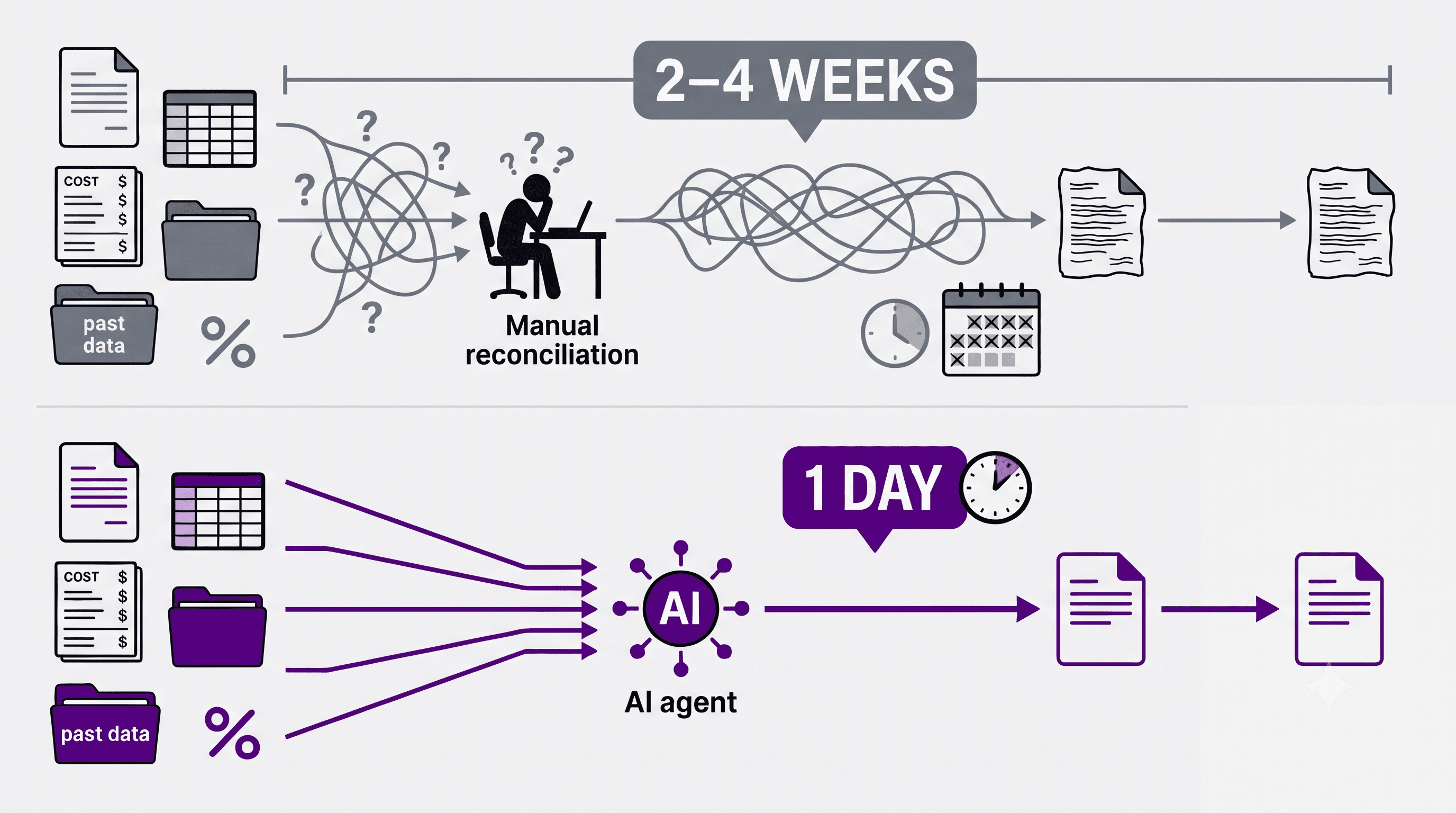
A commercial contractor spends 2-4 weeks assembling a bid. His team puts together takeoffs, subcontractor costs, historical data, computes margin, and reconciles across spreadsheets.
His competitor runs agents that ingest the plans, generates quantity takeoffs, looks at past projects, and produces a first draft in minutes. By the end of the day, he's got a complete bid package.
Whether or not you're in the building business, a version of this is happening all across the economy. Companies of all shapes and sizes are investing in AI capabilities, unlocking speed and savings opportunities that put them ahead of their competitors. Especially if you're leading a mid-market enterprise, this guide on how to successfully adopt AI and unlock opportunities is for you.
This series is a guide for businesses seeking to adopt operational AI and agents as a lever for growth. Across five parts, we'll walk through:
- Why adopt AI now, and what your options are
- How to work effectively with an AI partner
- How to evaluate an AI partner
- Structuring your collaboration for the best results
- What not to do — the common sticking points that hinder a profitable AI venture
Let's start with the question every leader is weighing right now.
When Should I Adopt Agentic AI?
Now!
Large enterprises have already moved all in. Roughly 83% of companies with 5,000+ employees have deployed AI, compared to about 42% of firms with 50–499 employees. This means that the big companies have a huge head start. But if you're competing with other mid-market companies, starting now puts you ahead.
AI adoption now specifically centers around agents. Gartner projects that 40% of enterprise applications will embed task-specific AI agents by the end of 2026, up from less than 5% in 2025, representing the fastest shift in the history of business software. 88% of executives plan to increase their AI budgets for agents specifically. This is where you should focus: AI agents that handle entire job functions end-to-end securely, correctly, and quickly. AI ROI at large companies averages at $3.7 for every $1 invested.
Companies that launch agents in 2026 will set a pace their industries have to match. It is genuinely an inflection point, the ideal moment to implement AI and organize your company around the rising capability of each new model generation.
What Does Adopting AI Look Like?
Adopting AI covers a wide spectrum of use cases. Imagine it as a pyramid your organization builds together.
The first layer is to give your team access to AI tools for work. Your employees should already be using capable AI assistants such as ChatGPT or Claude for drafting, research, and analysis. But don't let that be where your company stops, or you'll get underwhelming results and be left behind competitors who are investing in AI agents.
The second layer is to connect your data and systems directly to your AI tools so that your team can easily work across systems, such as CRMs, email, etc. with ease.
The real enterprise value is AI workflow automation and AI process automation. Custom AI agents, tailored to your organization can read your systems, follow your processes, make supervised decisions, and complete entire workflows end to end. Over time, agents own entire business functions and compress timelines from weeks to hours.
Getting there usually calls for real, strategic AI implementation. The value comes from deep integration. The agent has to live inside your IT infrastructure, your data, and your way of doing business. Whenever your team spends time on repeatable, rote work, such as qualifying and routing inbound requests, drafting proposals and reports, reconciling data across systems, handling tier-one support, preparing account or case files, you should consider deploying custom AI agents. The more an agent is built around how *your* company works, the more it's worth.
Should I Build AI In-House or Hire an Agency?
The AI-agency-vs-in-house question is important to solve early on. Nobody knows your business like you and your employees, but on the other hand, complex AI deployments require technical expertise and experience to succeed.
It's often worth tinkering with some off-the-shelf tools such as N8 or Lovable to put together a proof of concept, but to avoid costly mistakes in production, you want to make sure your AI agents are built properly. If you have in-house software engineers with AI experience to build and maintain agents for you, that's often the right call. However, most mid-market firms outside the tech sector do not. Given the current costs of hiring engineers with AI experience (some labs pay north of $500K), you should be realistic about what you can achieve in-house.
This is why many mid-market companies turn to AI development companies or a specialized AI automation agencies. You get access to top AI talent at affordable prices and should expect fast results, deep expertise, and none of the long-term hiring overhead. Experienced AI consultants have already navigated the failure modes. When you hire an AI agency, you're buying that hard-won battle scars along with the agents. Good AI agencies deliver the custom AI agents your workflows need, at production grade, in a fraction of the time an internal team would take to reach the same point.
Want to learn more about AI agents?
Our team of former Palantir engineers and AWS architects have implemented hundreds of agents for dozens customers.
Book a callThere's a third option some leaders turn to: traditional consulting firms that advise on strategy but don't build well. For mid-market companies, a slide deck about your "AI opportunities" is rarely the bottleneck. You want working agents. The most useful partners close that gap, combining the strategy of a consultancy with the delivery of a development agency, and they hand you running agents that own entire job functions.
For most mid-market firms, then, the highest-efficiency path to AI transformation is a partner who builds custom agents around your operation and stays accountable for whether they really work. In the next part of this series, we'll talk about how to work effectively with an AI partner so the engagement produces agents your team trusts and uses.